
Heat is the main long-term stress on power electronics, and solar pumping sites rarely make it easy to remove. Drives are often mounted outdoors beside boreholes, reservoirs or irrigation channels, in regions where strong sun and high ambient temperatures are normal for much of the year.
As ratings climb into tens or hundreds of kilowatts, the losses inside a solar pump drive grow with them. The layout of the enclosure, its mounting position and the space around it then decide whether that heat leaves the unit or stays inside to shorten component life.
Where the Heat Is Generated
Inside a pump drive, most losses arise in the power semiconductors. IGBTs dissipate energy each time they switch and for as long as they conduct, while the input rectifier, DC-bus capacitors and internal wiring add smaller amounts. Because these losses rise steeply with current, a unit rated for several hundred amperes has to reject far more heat than a small one, even when both show a similar efficiency percentage.
Timing makes the problem harder. A solar VFD carries its heaviest load around midday, when irradiance is strongest and the pump runs fastest, which is also when air temperature and direct radiation on the housing reach their peak.
Dust on heatsink fins compounds the effect, because even a thin layer insulates the metal and narrows the channels that air must pass through. Thermal design therefore has to work at the worst moment of the day, not at an average condition.
Sealed Enclosures and Forced-Air Cooling
Outdoor pumping sites expose equipment to dust, rain, insects and occasional flooding, so many units use sealed housings. An IP65 rating means the enclosure is dust-tight and protected against water jets, but a sealed box cannot rely on outside air flowing across the circuit boards.
Heat has to travel through heatsinks and housing surfaces instead, with fans moving air over the external cooling area. Ventilated designs with filtered air paths are an alternative, but filters clog quickly in dusty fields and need regular cleaning to keep their rated airflow.
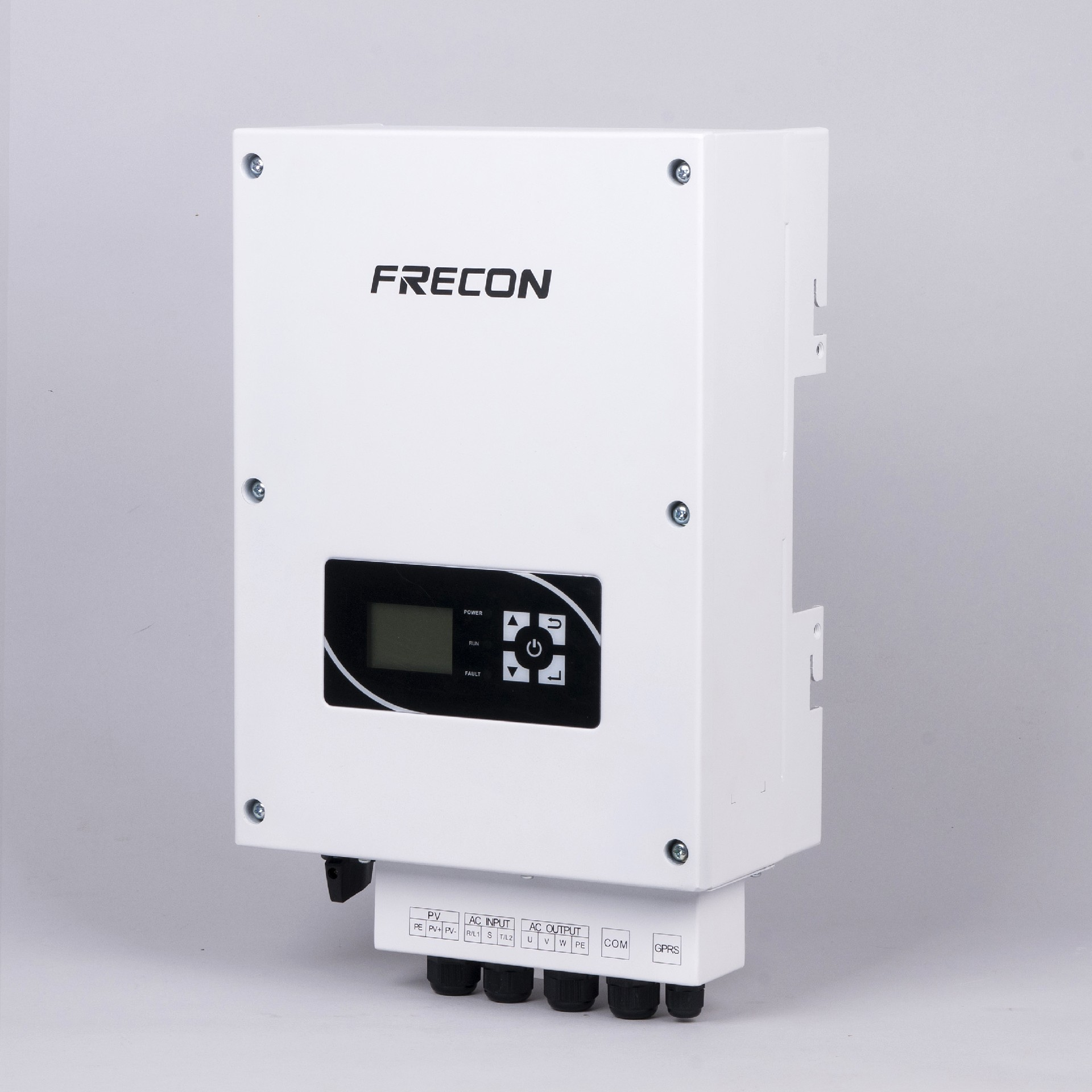
FRECON’s PV380 is an IP65 wall-mounted solar-pump inverter with forced-air cooling, and the company’s PV580 also uses an IP65 enclosure. In general, vertical wall mounting lets warm air rise along the cooling surfaces, so the fans assist natural convection rather than work against it.
A solar pump drive installed on its side or at an angle loses part of that advantage, which makes mounting orientation as much a thermal parameter as an installation detail, and installers benefit when a solar pump inverter manufacturer specifies it together with the protection rating.
Clearance, Shade, Temperature and Altitude
An enclosure can only reject heat into the air around it. Open space above and below the unit lets cool air in and warm air out, whereas stacking drives directly above one another turns the exhaust of the lower unit into the intake of the upper one.
A simple canopy that shades the housing removes the solar heat load on the enclosure itself, and a site kept free of oil mist and salt deposits protects fan blades and heatsink fins from fouling.
Ambient limits complete the picture. FRECON lists an operating range of -10 to 60°C for the PV380, with output current derated by 1.5% per degree above 40°C, so at 50°C the rated output current is reduced by 15%.
Altitude is permitted up to 2000 m, with 1% derating for each additional 100 m above 1000 m, and the installation conditions exclude direct sunshine, corrosive or combustible gases, oil mist, steam, dripping and salinity.
At a hot, high-altitude site, a solar VFD may therefore need a larger frame than the pump rating alone suggests, a sizing step that a solar pump inverter manufacturer can confirm from the same derating figures. If the derated output current still covers the pump motor’s full-load current, the original frame remains adequate; if not, the next size up is the safer choice.
High Voltage, Long Cables and the Complete Layout
Higher power usually brings higher voltage. Raising the voltage lowers current for the same power, which cuts conduction losses in both the drive and the cables. An undersized cable works against this, heating up and losing voltage before power reaches the motor terminals.
The PV600 6T configuration accepts 500–1140V DC or three-phase 690V AC input and supplies three-phase 690V AC output, while the PV500 4T configurations use 230–800V DC input, with a 900V DC-input version available as a customised option. Where the pump sits far from the drive, an output reactor, available for long-cable water-pump applications, protects the motor and cable from voltage stress.
FRECON‘s solar-pump range covers the PV500, PV580, PV150A, PV600, PV380 and PV01 series, and the PV150A and PV500 reach an MPPT tracking efficiency of 99%. Thermal layout does not change that tracking figure, but it determines whether a solar pump drive can sustain full output through the hottest afternoons.
The checklist itself is short: an enclosure rated for the site, vertical mounting with clearance, shade over the housing, and derating wherever temperature or altitude demands it. Once these points are settled with a solar pump inverter manufacturer before installation, the pump can keep its rated duty, and the same rules apply to any solar VFD mounted beside it.
